Konark Sun Temple: The Chariot of the Sun in Stone
Twenty-four carved wheels, seven horses and a temple built as a sundial in stone: the history, legends and meaning of the Konark Sun Temple, and how to visit.
Author: MARG TeamPublished: 4 min read
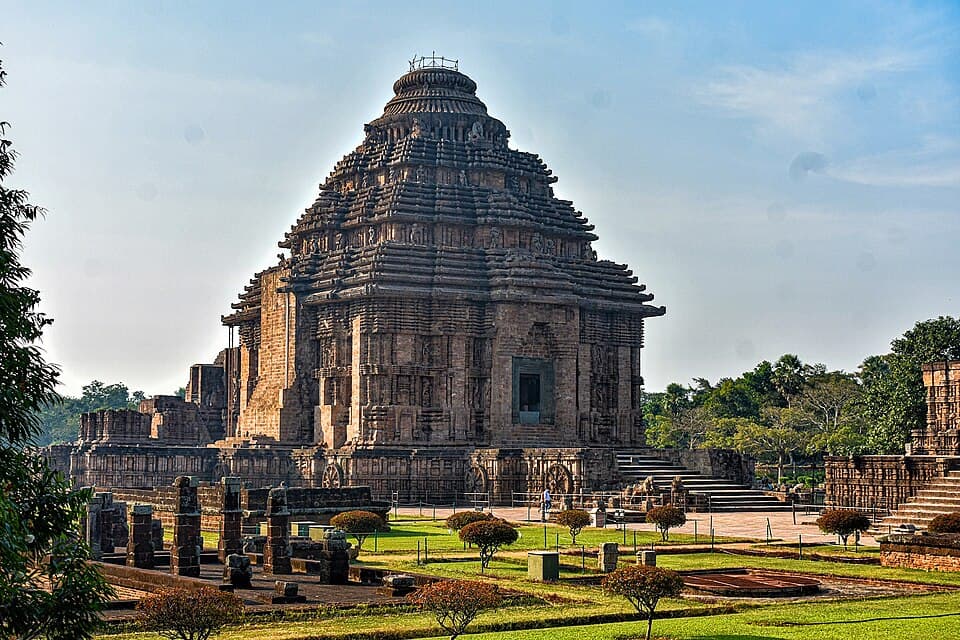
On the coast of Odisha stands one of the boldest ideas in Indian architecture: an entire temple shaped as the chariot of Surya, the Sun god, drawn by seven horses on twenty-four giant stone wheels. The Konark Sun Temple is a UNESCO World Heritage Site and one of India's most loved monuments. This is its story, and a guide to seeing it well.
Who built the Konark Sun Temple?
Konark was built around 1250 CE by King Narasimhadeva I of the Eastern Ganga dynasty, the dynasty that also gave Puri its Jagannath temple. The name joins "kona", corner, and "arka", the Sun. European sailors, who used its dark tower as a landmark, called it the Black Pagoda, to set it apart from the White Pagoda of Puri.
The legends of Konark
Samba and the healing Sun
The Puranas tell of Samba, a son of Krishna, who was struck by leprosy after a curse. He worshipped Surya for twelve years at Mitravana, near the meeting of the Chandrabhaga river and the sea, and was healed. In gratitude he built a temple to the Sun, and Konark is remembered as that holy place.
Dharmapada, the boy who finished the temple
A well-loved Odia legend says twelve hundred craftsmen worked for twelve years under the master architect Bisu Maharana, yet could not set the crowning stone. Bisu's twelve-year-old son Dharmapada, who had come looking for his father, solved the puzzle and placed it. Fearing the king's anger at the craftsmen's failure, the boy is said to have given his life to the sea.
Reading the chariot
- Twenty-four wheels: often read as the hours of the day or the fortnights of the year. Their eight spokes cast shadows precise enough that some wheels work as sundials.
- Seven horses: the seven days of the week, or the seven colours of sunlight.
- The carvings: dancers and musicians, elephants and hunting scenes, kings and daily life, gods and mithuna couples cover every surface.
- Three Surya images: on the outer walls the Sun is shown at dawn, at noon and at sunset.

The Konark wheel is now a symbol of India itself: it appears on the ten-rupee note.
The temple today
The great sanctum tower that once rose behind the hall has fallen. What stands is the jagamohana, the audience hall, which was filled with sand and sealed in 1903 to keep it from collapsing. The Archaeological Survey of India cares for the site, and it was declared a UNESCO World Heritage Site in 1984. Worship no longer takes place here; Konark is visited as a monument, and photography is allowed.
Festivals at Konark
- Chandrabhaga Mela: on Magha Saptami, pilgrims bathe at nearby Chandrabhaga beach and greet the rising Sun.
- Konark Dance Festival: every December, India's classical dancers perform against the temple at night.
- Surya festivals: Makar Sankranti and Chhath Puja bring worshippers of the Sun.
Planning your visit
- Getting there: about 35 km from Puri and 65 km from Bhubaneswar by road.
- Best time: October to March, early in the morning for soft light and fewer crowds.
- Guides: a licensed guide brings the carvings to life; allow at least two hours.
- Combine: Puri's Shri Jagannath Temple and the temples of Bhubaneswar make up the Odisha Golden Triangle. Konark also anchors MARG's Sun Temples of Bharat, with Modhera in Gujarat.
Visit Konark and collect its card
Konark has its own Sacred Card on MARG. Check in when you arrive, and add Puri and Modhera to complete your journey with the Sun.
- Find one nearby. Open MARG and look at Nearby Temples, or browse temples across India.
- Check in when you arrive. Your visit is verified at the temple and added to your Spiritual Passport.
- Collect the Sacred Card. Most temples on MARG have their own card, unlocked on your first verified visit.
Konark Sun Temple: frequently asked questions
Who built the Konark Sun Temple?
King Narasimhadeva I of the Eastern Ganga dynasty, around 1250 CE.
Why is it called the Black Pagoda?
European sailors used its dark tower as a landmark and called it the Black Pagoda, to tell it apart from Puri's white Jagannath temple.
How many wheels does the Konark Sun Temple have?
Twenty-four, pulled by seven horses. Some of the wheels work as sundials.
Is worship performed at Konark today?
No. Konark is a protected monument cared for by the Archaeological Survey of India.
When is the Konark Dance Festival?
Every December, against the temple as a backdrop.
The MARG app
Visit a temple near you
Take darshan, then check in with the MARG app: the visit joins your Spiritual Passport and you collect that temple's Sacred Card.