Temple Etiquette in India: A Gentle Guide for Every Visitor
What to wear, footwear, phones and photography, darshan, pradakshina and prasad: a respectful guide to visiting Hindu temples in India.
Author: MARG TeamPublished: 4 min read
A Hindu temple is the home of the deity, and a visit is a visit to the divine. Customs differ from temple to temple and region to region, but a few gentle habits make every darshan calmer for you and for everyone around you. Here is what to know before you go.
Before you go
- Bathe and dress cleanly. Many devotees visit after a bath, and some fast until after darshan.
- Check the timings. Most temples close in the afternoon, and darshan pauses during aarti and bhog. MARG shows timings on every temple page.
- Carry little. Many temples do not allow bags, phones, cameras or leather items inside; leave them in the cloakroom or the car.
What to wear
Modest, comfortable clothes that cover the shoulders and knees are welcome everywhere. Some temples have strict dress codes, especially in Kerala and Tamil Nadu: men may be asked to wear a dhoti or mundu and remove their shirts, and women to wear a saree, salwar kameez or long skirt. Check the temple's dress code on MARG before you visit, and carry a shawl or stole just in case.
Entering the temple
- Remove your footwear at the stand outside, and wash your hands and feet if water is provided.
- Ring the bell as you enter, to announce yourself to the deity and still the mind.
- Keep your voice low and your phone silent.
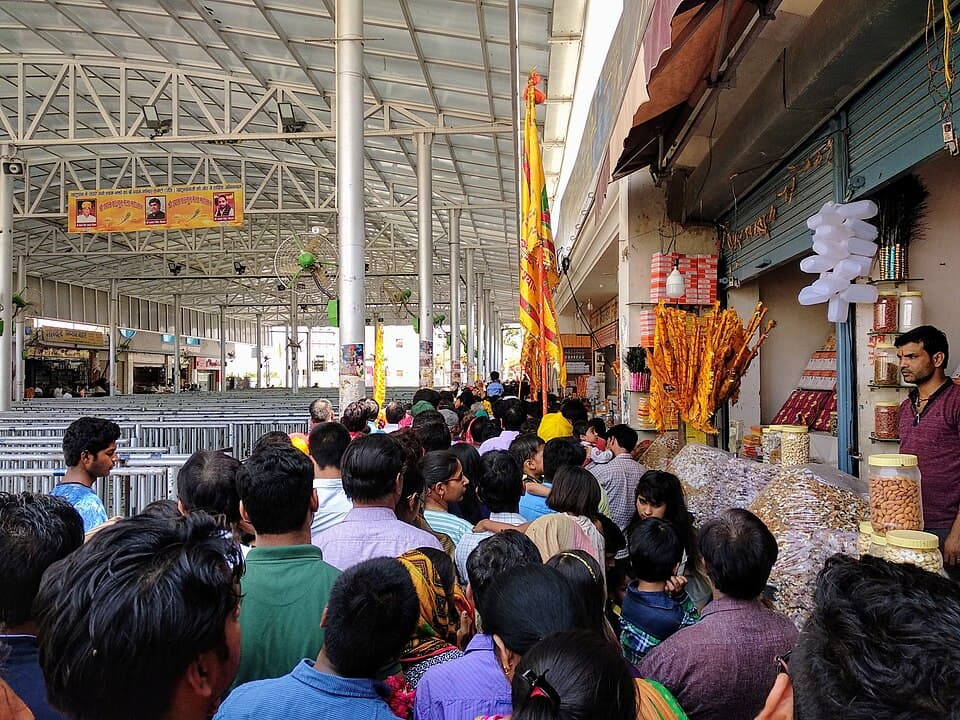
- Join the queue patiently. Let elders, children and people with disabilities go first where there is a separate line.

During darshan
- Stand with folded hands, look at the deity and pray quietly. Darshan, "seeing" and being seen by God, is the heart of the visit.
- Do not touch the idol unless the temple allows it; in many temples only the priests may.
- Move on gently so that others can have darshan too.
- Offer flowers, fruit, sweets or coins as the temple allows; most have counters for offerings.
Pradakshina: walking around the deity
Pradakshina, circling the sanctum, is done clockwise, keeping the deity on your right. In Shiva temples devotees traditionally walk only half the circle and turn back at the outlet of the abhishek water, without crossing it.
Prasad and the temple's rules
- Receive prasad with your right hand, or with both hands cupped, and eat it rather than throwing it away.
- Follow the temple's rules on photography. Many do not allow photographs of the sanctum.
- Some temples admit only Hindus to the inner sanctum, among them Shri Jagannath in Puri and Guruvayur in Kerala; respect such rules.
- Donate only at official counters, and ask for a receipt.
Phones, photos and checking in on MARG
Some temples, such as Shri Jagannath in Puri, Kashi Vishwanath and Somnath, do not allow phones inside. MARG's check-in works from the temple premises outside, so check in before you deposit your phone, then enjoy darshan without it.
Visiting with children and elders
- Visit early in the morning, when queues are short and it is cool.
- Many large temples have wheelchairs, ramps and separate queues for senior citizens; ask at the office.
- For hill and trek temples, start early, carry water and do not rush the climb.
Visit a temple near you
Put these habits into practice at a temple near you. Each temple on MARG shows its timings, dress code and rules, and has its own Sacred Card.
- Find one nearby. Open MARG and look at Nearby Temples, or browse temples across India.
- Check in when you arrive. Your visit is verified at the temple and added to your Spiritual Passport.
- Collect the Sacred Card. Most temples on MARG have their own card, unlocked on your first verified visit.
Temple etiquette: frequently asked questions
What should I wear to a Hindu temple?
Modest clothes that cover the shoulders and knees. Some temples, especially in Kerala and Tamil Nadu, require traditional dress.
Can I take my phone into a temple?
Many temples allow phones in silent mode; some, like Jagannath Puri, Kashi Vishwanath and Somnath, do not allow them inside.
Which way do you walk around a temple?
Clockwise, keeping the deity on your right.
Why do we ring the bell in a temple?
To announce our arrival to the deity and to clear the mind of distractions before darshan.
Can non-Hindus visit Hindu temples?
Most temples welcome everyone. A few, such as Jagannath in Puri and Guruvayur, admit only Hindus to the inner areas.
The MARG app
Visit a temple near you
Take darshan, then check in with the MARG app: the visit joins your Spiritual Passport and you collect that temple's Sacred Card.