Navratri: Nine Nights of the Goddess, Nine Forms and Nine Colours
The nine forms of Durga, the stories behind Navratri, how India celebrates it, the Navratri colours, fasting rules and the Shakti temples to visit.
Author: MARG TeamPublished: 4 min read
Navratri means "nine nights". For nine nights India worships the Goddess, Durga, in her nine forms, with fasting, prayer, music and dance, and on the tenth day celebrates the victory of good over evil. This guide covers the stories, the nine forms, the colours, the fasting rules and how each region celebrates.
How many Navratris are there?
Four in a year. The two great ones are Sharad Navratri in autumn (Ashwin), the most widely celebrated, and Chaitra Navratri in spring, which ends on Ram Navami. The two Gupt (secret) Navratris, in Magha and Ashadha, are kept mainly by tantric and Shakta practitioners. Chaitra Navratri 2027 runs from 7 to 15 April.
The story of Navratri
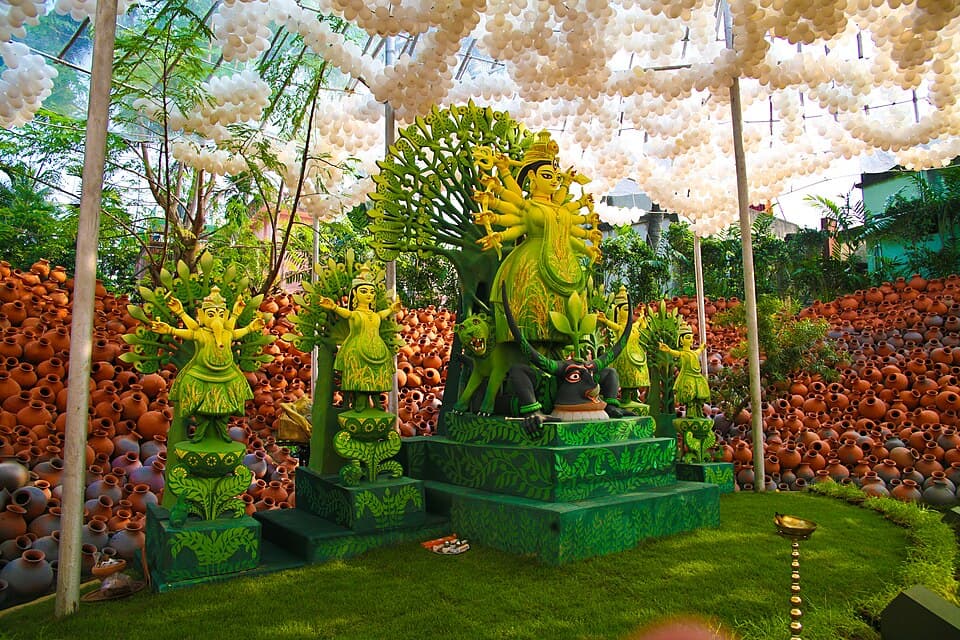
The buffalo demon Mahishasura won a boon that no man or god could kill him, and drove the gods out of heaven. The gods poured their combined power into one being, and Goddess Durga rose, riding a lion, a weapon in each of her many hands. She fought Mahishasura for nine days and nights and slew him on the tenth, which is why she is called Mahishasuramardini. That tenth day is Vijayadashami.
Another story says Rama worshipped Durga before his battle with Ravana and won on Vijayadashami, which is why North India burns effigies of Ravana on Dussehra.
The nine forms of Durga (Navadurga)
- Shailaputri, daughter of the mountain Himavan
- Brahmacharini, the Goddess in penance
- Chandraghanta, with a half-moon like a bell on her forehead
- Kushmanda, who created the universe with her smile
- Skandamata, mother of Kartikeya
- Katyayani, the warrior who slew Mahishasura
- Kalaratri, the fierce destroyer of darkness
- Mahagauri, radiant and pure
- Siddhidatri, giver of spiritual powers
Navratri colours
A popular modern custom, strongest in Maharashtra and Gujarat, assigns a colour to each day of Navratri, following the weekday on which it falls: Sunday orange, Monday white, Tuesday red, Wednesday royal blue, Thursday yellow, Friday green and Saturday grey. For Chaitra Navratri 2027 that gives:
- Day 1, Wednesday 7 April: royal blue
- Day 2, Thursday 8 April: yellow
- Day 3, Friday 9 April: green
- Day 4, Saturday 10 April: grey
- Day 5, Sunday 11 April: orange
- Day 6, Monday 12 April: white
- Day 7, Tuesday 13 April: red
The colours for the last two days vary between published lists, often pink, purple or peacock green; follow the list your temple or community shares.
How India celebrates Navratri
- Gujarat: Garba and Dandiya Raas every night around a lamp for the Goddess.
- West Bengal: Durga Puja, with artistic pandals, the dhunuchi dance, sindoor khela and the immersion on Dashami.
- Tamil Nadu, Karnataka and Andhra Pradesh: Golu or Bommai Kolu, steps of dolls; Ayudha Puja honours tools and books.
- Mysuru: the Dasara festival and the Jamboo Savari procession of Goddess Chamundeshwari.
- North India: Ramlila performances ending with Ravana's effigy burned on Dussehra.
- Himachal Pradesh: Kullu Dussehra, which begins on Vijayadashami and lasts a week.

Navratri rituals and fasting rules
- Ghatasthapana: a kalash is installed on day one, often with barley seeds sown around it.
- Akhand jyot: a lamp kept burning for all nine days.
- Durga Saptashati: the 700 verses of the Devi Mahatmya recited at home or in temples.
- Fasting: many avoid grains, onion, garlic and meat, and eat fruit, milk, sabudana, kuttu and singhara flour, with sendha namak (rock salt).
- Kanya Puja: on Ashtami or Navami, young girls are worshipped as forms of the Goddess and fed.
Shakti temples to visit during Navratri
Navratri is the busiest time at the Goddess's great temples: Vaishno Devi in Jammu, Kamakhya in Guwahati, Jwala Ji and Naina Devi in Himachal, Ambaji in Gujarat, Kalighat and Dakshineswar in Kolkata, and Mahalakshmi in Kolhapur. Follow them on MARG's Shakti Peeth Yatra.
Visit a Devi temple this Navratri
Take darshan of the Goddess on one or all nine nights. Each of her temples on MARG has its own Sacred Card.
- Find one nearby. Open MARG and look at Nearby Temples, or browse temples across India.
- Check in when you arrive. Your visit is verified at the temple and added to your Spiritual Passport.
- Collect the Sacred Card. Most temples on MARG have their own card, unlocked on your first verified visit.
Navratri: frequently asked questions
When is Chaitra Navratri in 2027?
From Wednesday 7 April to Thursday 15 April 2027, ending on Ram Navami.
What are the nine forms of Durga?
Shailaputri, Brahmacharini, Chandraghanta, Kushmanda, Skandamata, Katyayani, Kalaratri, Mahagauri and Siddhidatri.
What are the Navratri colours?
Each day takes the colour of its weekday: Sunday orange, Monday white, Tuesday red, Wednesday royal blue, Thursday yellow, Friday green and Saturday grey. The last two days vary by list.
What can I eat during the Navratri fast?
Fruit, milk and curd, sabudana, kuttu and singhara flour, potatoes and sendha namak. Grains, onion, garlic and meat are usually avoided.
What is the difference between Navratri and Durga Puja?
They are the same season of the Goddess. Bengal celebrates its last five days as Durga Puja with pandals; elsewhere all nine nights are Navratri.
MARG ऐप
Visit a temple near you
Take darshan, then check in with the MARG app: the visit joins your Spiritual Passport and you collect that temple's Sacred Card.