Skip to content
MARG

Konark · Odisha

Konark Sun Temple

  • सूर्य
  • Odisha Golden Triangle
  • Sun Temples of Bharat
  • Odisha

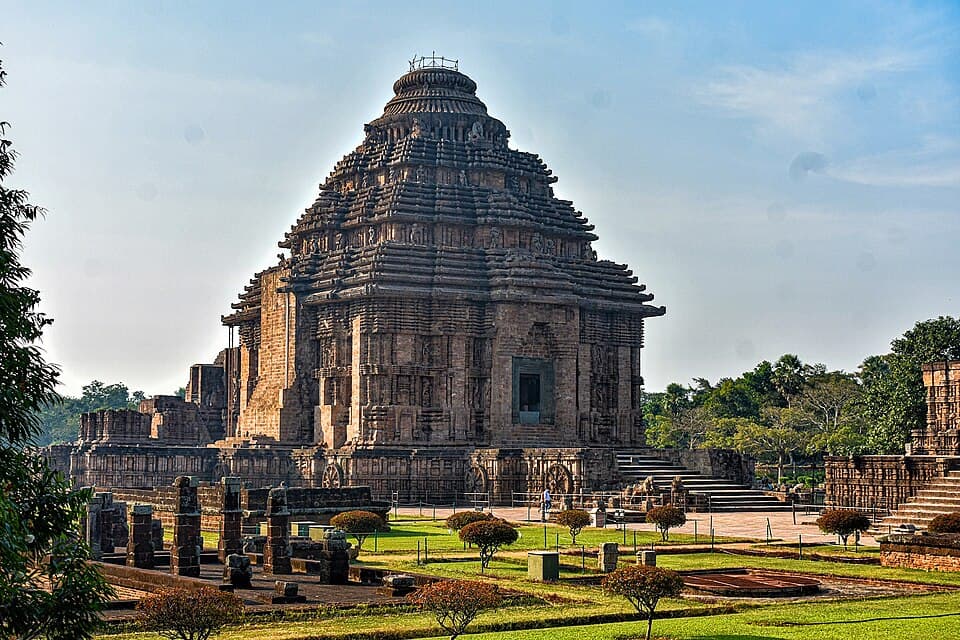
Photo: Photo: Subham9423 · CC BY-SA 4.0 via Wikimedia Commons

About Konark Sun Temple

The 13th-century temple is carved as Surya's giant stone chariot with 24 wheels — a UNESCO World Heritage Site.

Location

Konark, Odisha19.8876° N, 86.0945° E

Directions open in Google Maps or OpenStreetMap from the temple's coordinates. MARG does not provide live navigation.

History

King Narasimhadeva I of the Eastern Ganga dynasty (reigned 1238–1264) built the temple around 1250 CE. Tradition links it to his victories over the Bengal Sultanate. The legend says 1,200 artisans worked on it for 12 years under the chief architect, Bisu Maharana. When they could not set the crowning stone, his 12-year-old son Dharmapada fixed it, then gave his life to save the artisans from the king's anger.

The main tower (deula) was about 70 m high. It collapsed between the 16th and 19th centuries, and nobody is sure why. Theories include weak foundations, lightning, and the removal of the crowning lodestone. Sailors used it as a landmark and called it the "Black Pagoda", to tell it apart from the whitewashed Jagannath temple at Puri, the "White Pagoda". Tradition holds that the presiding image of Surya was moved to Puri.

In 1903, to stop the surviving Jagamohana (assembly hall) from collapsing, the British government in Bengal filled it with sand and sealed it. The Archaeological Survey of India (ASI) has looked after the site since then and has been studying how to remove the sand safely. UNESCO listed the temple as a World Heritage Site in 1984. A Konark wheel is on the back of the ₹10 note.

Mythology

The Samba legend:

  • Samba, Krishna's son, was cursed with leprosy.
  • He worshipped Surya for 12 years at Mitravana, where the Chandrabhaga river met the sea.
  • Surya cured him, and Samba founded a shrine to the Sun there.

That is why Konark is called Arka Kshetra, the Sun's holy ground, one of Odisha's five sacred kshetras. The name joins *Kona* (corner) and *Arka* (the Sun).

The whole temple shows Surya's chariot. The seven horses are the seven days of the week. The 24 wheels are the hours of the day, or the 12 months in their bright and dark halves. The eight major spokes of each wheel are the eight prahars of the day. The wheels work as sundials: the shadow of the axle on the spokes tells the time.

Every year on Magha Saptami (Rath Saptami), pilgrims bathe at sunrise at Chandrabhaga beach, about 3 km away, and pray to the rising Sun. This is the Chandrabhaga Mela.

Architecture

Built in the Kalinga style from khondalite stone, with laterite and iron beams. The complex has three parts on one east–west axis:

  • the Rekha deula, the sanctum, which has collapsed; only its base and walls remain
  • the Pidha deula, also called the Jagamohana or assembly hall, which still stands, about 39 m high, with three tiers of sculpted musicians and dancers
  • the separate Nata Mandir, the dance hall, now roofless

Key features:

  • 24 wheels, each about 3 m across, carved along the plinth.
  • Seven horses pulling the chariot, though only a few survive.
  • At the entrance, Gajasimha: a lion crushing an elephant, which crushes a man.
  • Three green-chlorite Surya images in the deula's niches, facing south, west and north, showing the Sun at dawn, noon and dusk.
  • A plinth carved with thousands of scenes of daily life, war, animals, music, dance and erotic art.

Also in the complex:

  • the Mayadevi temple, older than the Sun Temple
  • a small Vaishnava temple
  • the remains of the bhoga (kitchen) hall

Rabindranath Tagore wrote of Konark: "Here the language of stone surpasses the language of man."

Visiting information

Timings

Every day06:00–22:00ASI monument, no worship inside. Light-and-sound show in the evening (ticketed). The ASI museum next door is closed on Fridays.

Timings, rules and access can change, especially on festival days and in season. Please confirm locally before you travel.

Dress code

No dress code is enforced, because it is a protected monument without active worship. Modest clothing is still recommended. Footwear is allowed in the complex. Wear a hat and carry water: there is little shade.

Visitor guidelines

It is an ASI ticketed monument. Typical prices (please check):

  • Indians and SAARC/BIMSTEC visitors: ₹40 at the counter, ₹35 online
  • foreigners: ₹600 at the counter, ₹550 online
  • children under 15: free

Book online at asi.payumoney.com, or scan the QR code at the gate. Don't climb on the plinth, wheels or sculptures. No drones, and no food inside the lawns. The Jagamohana interior is sealed. Licensed ASI guides are available at the gate.

How to reach
  • Road: Puri is about 35 km away along the Puri–Konark Marine Drive, and Bhubaneswar about 65 km. Buses and shared autos run from Puri and Bhubaneswar.
  • Rail: the nearest stations are Puri (about 35 km) and Bhubaneswar (about 65 km).
  • Air: Biju Patnaik International Airport, Bhubaneswar, is about 65 km away.
Parking

Paid parking for cars and buses near the main gate and ticket plaza.

Accommodation

There are a few options in Konark, including OTDC Panthanivas and private lodges near the market and eco-resorts at Ramachandi Beach. Most visitors stay in Puri or Bhubaneswar and make a day trip.

Prasad

No worship is offered at the main temple, so there is no prasad. For darshan, the Ramachandi and Chandrabhaga temples are close by, as is Jagannath at Puri. Food stalls and restaurants line the market road outside the gate.

Facilities

  • Parking
  • Drinking Water
  • Restrooms
  • Wheelchair Access

Related Pilgrimage Routes

Yatras on MARG that include Konark Sun Temple.

Odisha Golden Triangle: Photo: Subham9423 · CC BY-SA 4.0 via Wikimedia Commons · Sun Temples of Bharat: Photo: The original uploader was Parmar uday at English Wikipedia . · CC BY 2.5 via Wikimedia Commons

Nearby Temples

Other temples on MARG close to Konark Sun Temple.

View all temples

Chandrabhaga Temple: Illustration · MARG temple art (not a photograph of this temple) · Ramachandi Temple: Illustration · MARG temple art (not a photograph of this temple) · Maa Bata Mangala Temple: Illustration · MARG temple art (not a photograph of this temple) · Bedi Hanuman Temple: Illustration · MARG temple art (not a photograph of this temple)